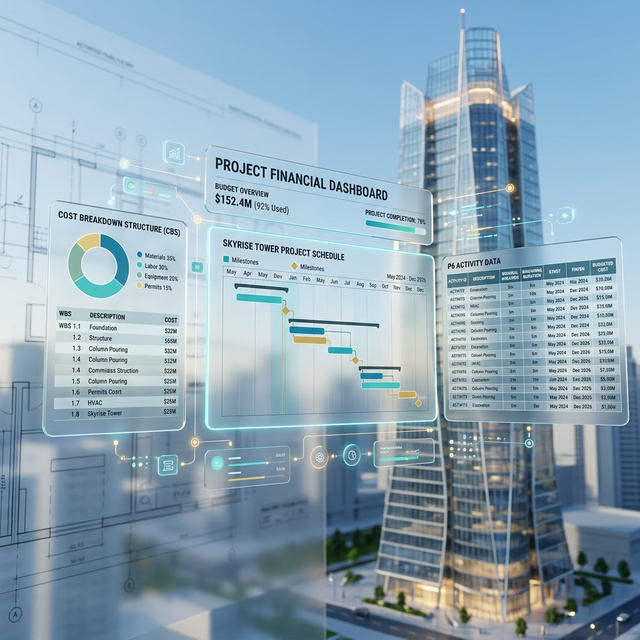
How to translate your company's Chart of Accounts into a technical setup inside Primavera P6 to generate WBS-independent financial reports.
Many planning engineers confuse Cost Accounts with the Cost Breakdown Structure (CBS). While a CBS focuses on dividing the project budget conceptually, the Cost Accounts feature in Primavera P6 performs a very different technical function: Coding expenses and resources with the company's accounting ledger numerical codes, regardless of where the activity sits in the project schedule.
In this technical tutorial, we will bypass the theory and dive straight into the Primavera P6 interface, detailing the exact mechanics of creating, assigning, and reporting on Cost Accounts.
Step 1: Setting up the Dictionary (Enterprise Data)
The first crucial technical detail about Cost Accounts in P6 is that they are Enterprise Data, not Project Data. This means the financial dictionary you build applies across all EPS nodes and projects in the database.
Execution:
- From the top menu, navigate to Enterprise → Cost Accounts.
- A window identical to the WBS dialog will appear, as P6 supports a hierarchical tree structure for Cost Accounts.
- Add your codes. These codes must be an exact match to the Chart of Accounts (COA) used by your accounting and cost control departments. (e.g., Code 4000 for Concrete Works, with child nodes 4010 for Material, 4020 for Labor).
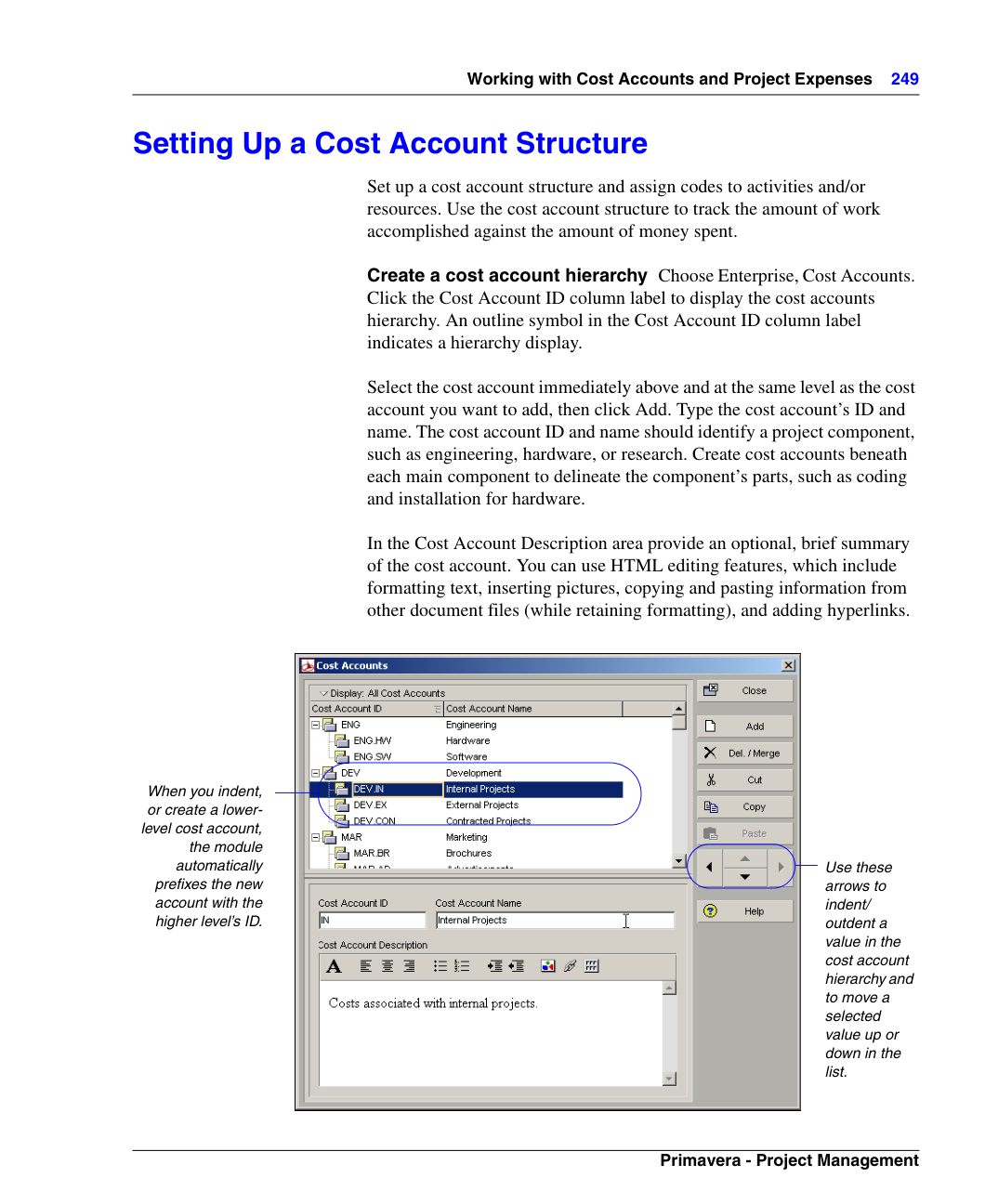 Fig (1): Establishing the hierarchical Cost Account dictionary in the Enterprise menu.
Step 2: The Assignment - The Critical Distinction
The most common technical mistake schedulers make is related to assignment: In Primavera P6, you DO NOT assign a Cost Account directly to an Activity. You assign it to the entities that actually incur cost: Resources or Expenses.
1. Resource Assignments
When you allocate labor, equipment, or materials to an activity, perform the following:
- Select the Activity.
- Navigate to the bottom Activity Details panel and select the Resources tab.
- Assign your required resource.
- Ensure the Cost Account column is visible in this specific tab, and select the corresponding financial code for that resource.
2. Expense Assignments
The Expenses functionality is where Cost Accounts truly shine. It is designed for Tracking Lump Sum subcontracts, permits, administrative fees, and non-resource-driven site overheads.
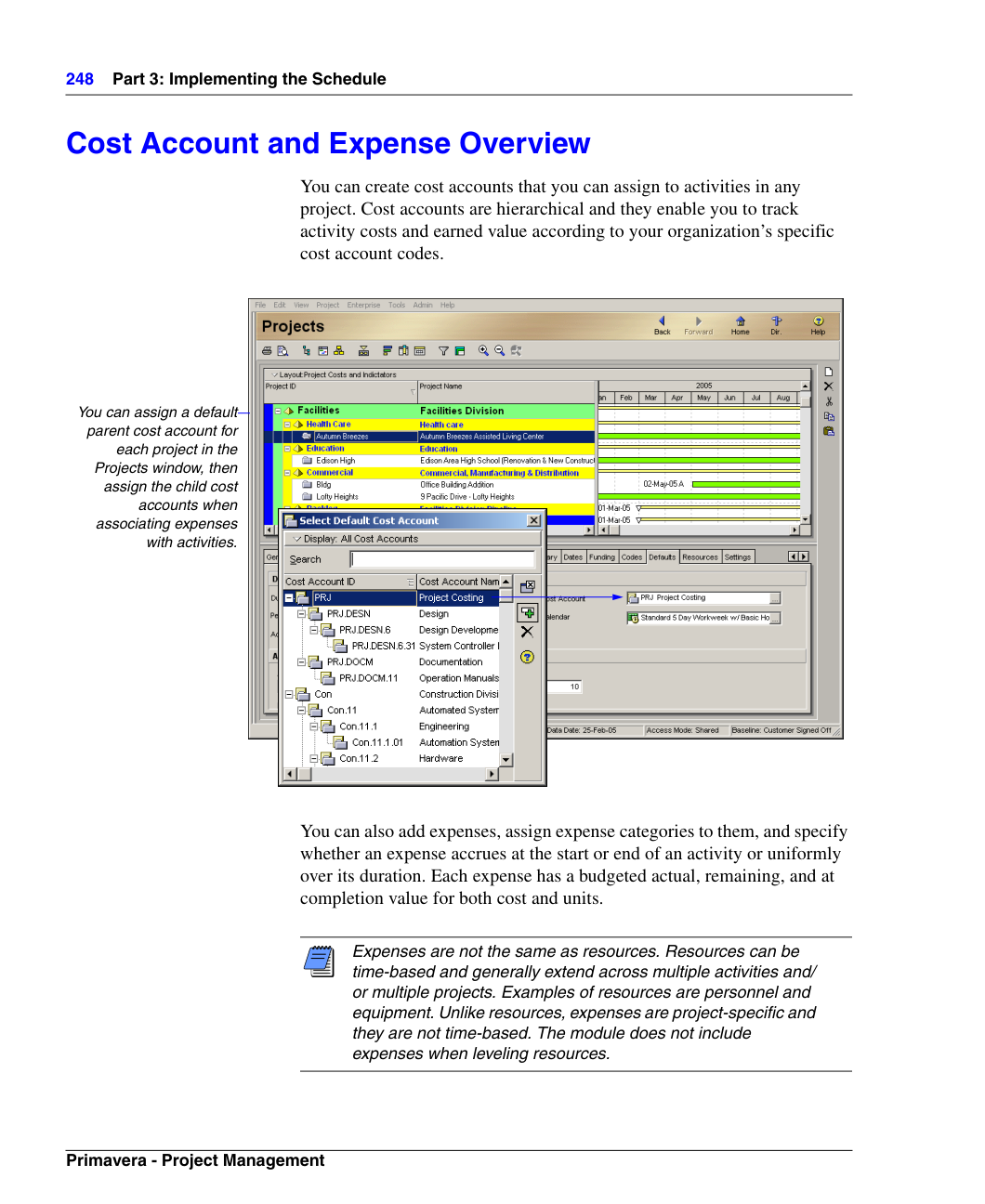 Fig (2): The Expenses tab, illustrating how to assign a unique Cost Account to individual expense line items within the same activity.
Step 3: EVM Roll-Up and Financial Reporting
Once your schedule is built, resources assigned, baseline set, and progress updated, Cost Accounts become the backbone of your Earned Value Management (EVM) reporting.
How to generate a pure financial ledger report from an engineering schedule:
- Navigate to the Activities window.
- Right-click and select Group and Sort.
- Remove the default WBS grouping.
- Set the 'Group By' parameter to: Cost Account.
- Add financial columns such as: Budgeted Total Cost, Actual Total Cost, Earned Value Cost, and Cost Performance Index (CPI).
The Result: P6 will collapse the engineering WBS timeline and display the schedule bucketed entirely by accounting codes. You will now be able to view the CPI for "Plastering Labor" across the entire project simultaneously. This pinpoints exactly where financial bleed is occurring—whether it's supplier pricing (Materials) or poor field productivity (Labor/Equipment).
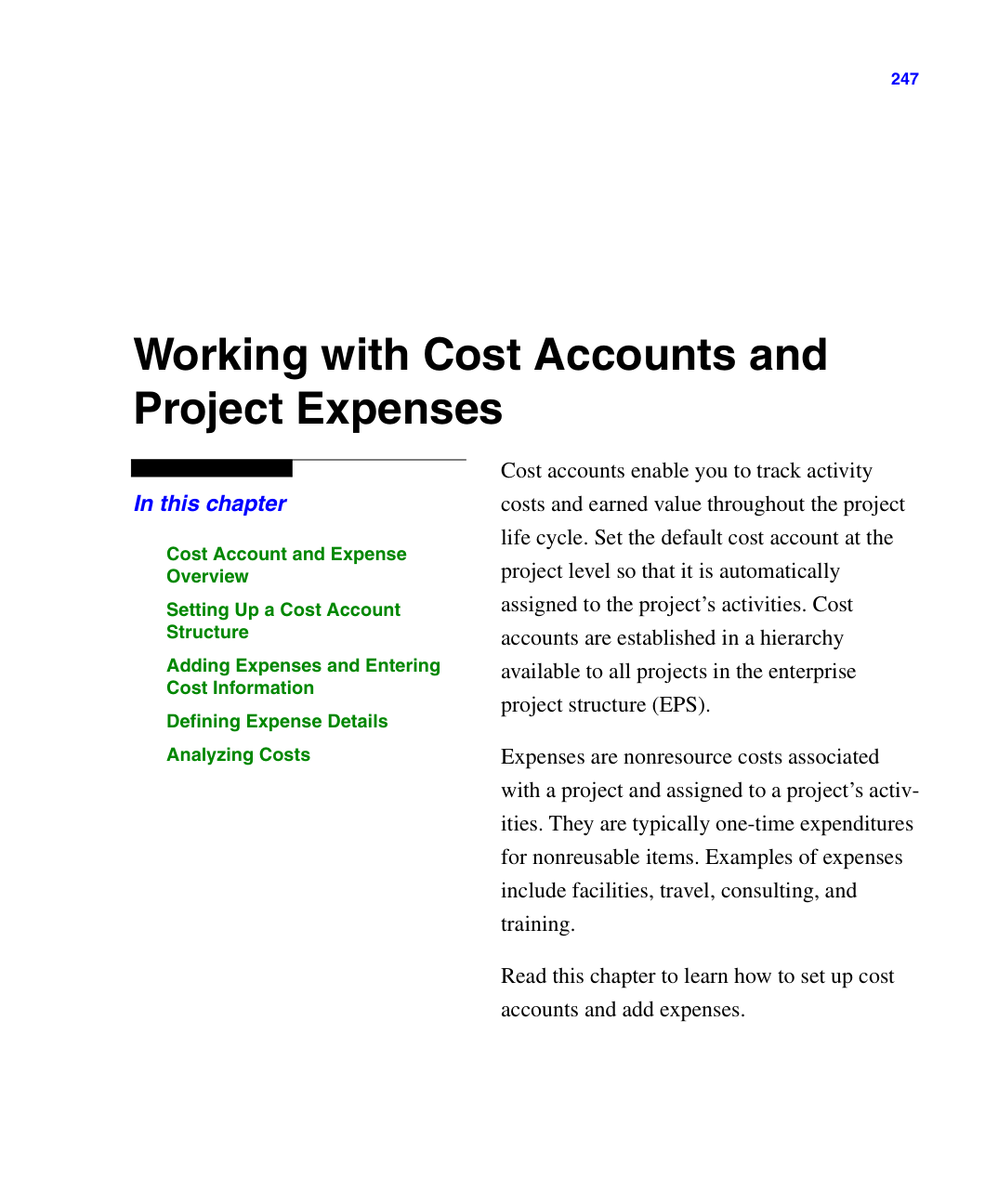 Fig (3): Rolling up activity costs using Group and Sort to format the schedule by accounting structure rather than WBS.
Conclusion for the Planning Engineer
Mastering Cost Accounts elevates Primavera P6 from a simple Time Scheduling engine into a comprehensive Total Cost Management platform. Proper implementation relies strictly on aligning the Enterprise dictionary with corporate accounting and executing precise assignments within the Resources and Expenses tabs.
Authored by the Technical Controls Team at BIMitPlaniT.
Cost Management in Construction Projects: Core Concepts
Cost management in construction projects is one of the most impactful functions on project success or failure. Many projects start with great promise but end in severe losses due to weak cost control and the absence of regular variance analysis. The Cost Engineer is considered the backbone of a project's financial performance control.
Costs in construction projects are divided into three main categories: Direct Costs (labor, materials, equipment directly tied to work items), Indirect Costs (office rent, administrative salaries, communication devices, safety and quality expenses), and Capital Expenses (purchasing long-term heavy equipment).
Modern Cost Estimation Techniques
The construction industry uses multiple estimation approaches depending on the project phase and available information accuracy:
- Analogous Estimating: Used in very early stages based on comparison with similar projects. Accuracy ±30-50%.
- Parametric Estimating: Relies on calibrated parameters (cost per m² of building, cost per hospital bed) to speed up estimation. Accuracy ±20-30%.
- BOQ-Based Estimating: Uses accurate quantities extracted from drawings or BIM model multiplied by unit rates. Accuracy ±5-10%.
- Definitive Estimate: Most accurate, corrected against current equipment rental rates and actual bid prices. Accuracy under 5%.
The Difference Between Budget and EAC
A very common mistake project managers make is confusing the original Budget (BAC) with the expected total cost (EAC). The budget only changes with a formal scope change, while EAC changes with each project performance update. The difference between the two (Variance at Completion) answers the question: how much over or under budget will the project finish?
Digital Transformation and Its Impact on Construction
The global construction industry is undergoing an unprecedented digital transformation, transitioning from traditional paper-based and manual methods to integrated digital work environments. This transformation is not merely about replacing paper with screens; it is a profound re-engineering of how projects are planned, designed, executed, and managed. Emerging technologies such as Artificial Intelligence (AI), Internet of Things (IoT), drones, and Digital Twins have become everyday tools on major project sites.
At the core of this transformation lies the absolute necessity for accurate, real-time data. Effective project management relies entirely on the team's capacity to collect, analyze, and share data quickly and reliably. This significantly mitigates the likelihood of costly errors, dramatically improves on-site safety protocols, and optimizes the consumption of resources and materials, ultimately leading to project delivery that is both on time and strictly within the allocated budget.
Occupational Safety and Quality Management in Modern Environments
Paralleling technological advancement is the increasing stringency of quality and occupational health and safety standards, aimed at preserving lives and minimizing incidents to absolute zero (Zero Harm). Safety programs have evolved beyond simple warning signs; they now incorporate predictive analytics that utilize historical incident data and monitor worker behaviors to identify hazardous zones before accidents even occur. Furthermore, teams are increasingly trained using Virtual Reality (VR) to simulate dangerous work environments without exposing them to actual risk.
On the quality front, the digitization of inspections and handovers (Digital Inspections) ensures that every single step is documented with microscopic precision. This substantially reduces disputes during the final project handover phase and guarantees that every component has been executed in strict adherence to the highest approved engineering standards and specifications.
The Crucial Shift Towards Sustainability and Green Building
Construction is no longer confined to merely erecting concrete and steel structures; it is now fundamentally concerned with the long-term environmental impact of these structures. The paradigm of sustainability and green building focuses intensely on reducing the carbon footprint of materials, maximizing energy and water consumption efficiency, and providing a maximally healthy environment for building occupants. The utilization of recycled building materials and the integration of renewable energy systems have evolved from optional features to mandatory requirements in many modern building codes.
Ultimately, the seamless integration of intelligent cost and schedule management, the strategic application of modern technology, and the strict enforcement of sustainability standards are what forge an advanced construction environment capable of meeting present demands without compromising the viability of future needs.
Eng. Sameh Badawy Sayed
Civil Engineer and BIM/Project Management specialist with extensive experience in planning and cost management across the Middle East. Founder of BIMitPlaniT.