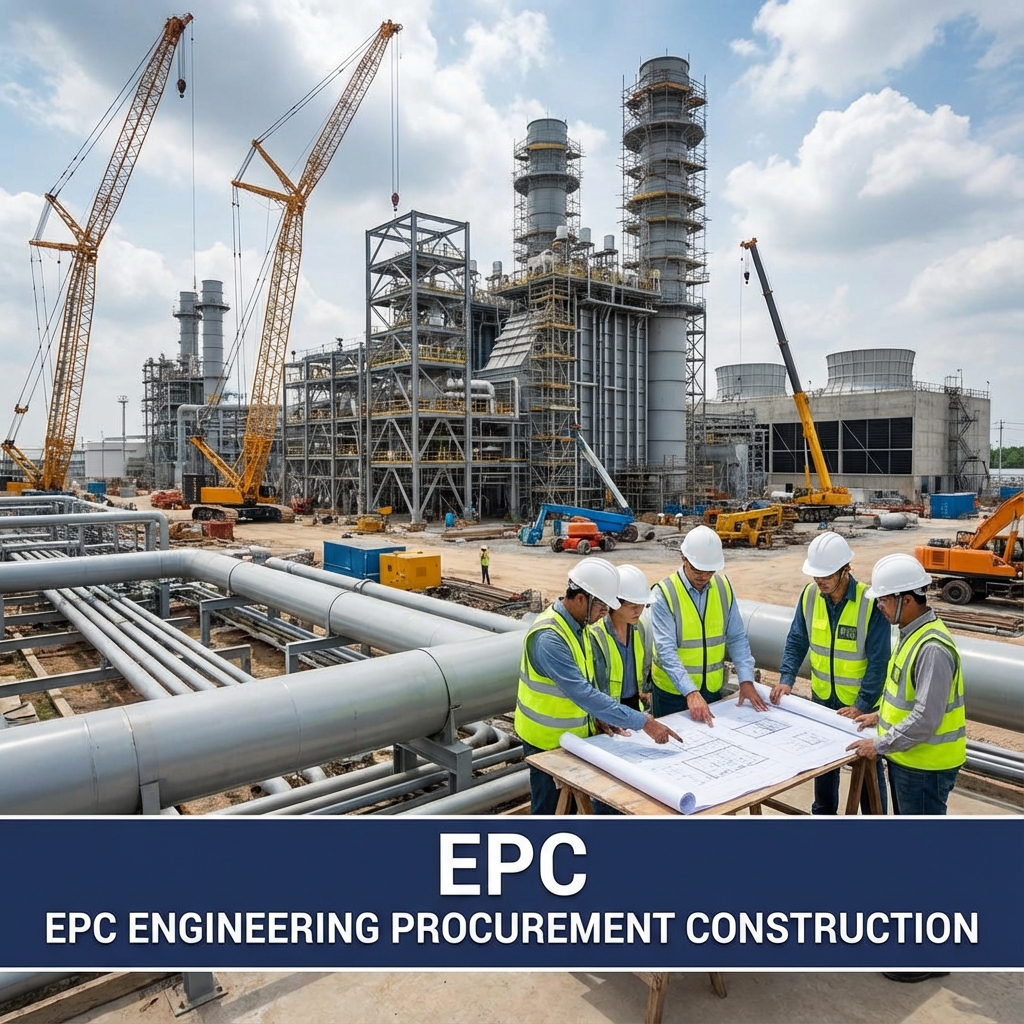
In the world of large-scale construction and industrial projects, the choice of contract type can make or break a project. EPC contracts — Engineering, Procurement, and Construction — represent one of the most powerful and widely used project delivery methods for power plants, oil refineries, desalination facilities, and major infrastructure projects. Understanding how EPC contracts work, their advantages and risks, and when to use them is essential knowledge for any construction professional or project owner.
This comprehensive guide walks you through everything you need to know about EPC contracts, from the basic definition to real-world implementation strategies, critical contract clauses, and hard-won lessons from major global projects.
🏭 What is an EPC Contract?
EPC stands for Engineering, Procurement, and Construction. In this delivery model, a single contractor (the EPC contractor) assumes complete and undivided responsibility for all three phases of a project:
Unlike traditional Design-Bid-Build contracts where the owner manages multiple separate contracts, EPC consolidates everything under one umbrella. The owner states their requirements (output specifications), and the EPC contractor delivers a fully functioning facility. This is why EPC is also often called a Turnkey contract — because theoretically, the owner just "turns the key" to use the finished facility.
🔧 The Three Pillars of EPC in Detail
E — Engineering Phase
The engineering phase is where the EPC contractor translates the owner's requirements document (called the Employer's Requirements or Performance Specification) into a complete, buildable design. This includes:
- Conceptual Engineering: Front-End Engineering Design (FEED) to validate technical feasibility and cost estimates.
- Detailed Engineering: Complete structural, mechanical, electrical, and piping drawings.
- Process Engineering: For industrial plants — process flow diagrams (PFDs), piping and instrumentation diagrams (P&IDs).
- Technical Specifications: Material standards, equipment specifications, performance requirements.
- Vendor Package Preparation: Technical data sheets and requests for quotation for major equipment.
P — Procurement Phase
The procurement phase involves sourcing everything needed to build the facility. With EPC, the contractor bears the procurement risk — cost overruns from material price volatility or supply chain delays fall on the contractor, not the owner. Key procurement activities include:
- Long-Lead Item Management: Ordering major equipment (turbines, pressure vessels, heat exchangers) early since lead times can exceed 12–24 months.
- Vendor Qualification and Selection: Evaluating suppliers against technical and commercial criteria.
- Inspection and Quality Control: Shop inspections at manufacturer facilities before shipment.
- Logistics and Customs: Managing international shipping, port handling, and import duties for large or specialized equipment.
- Spare Parts Procurement: Two-year operational spares are typically included in EPC scope.
C — Construction Phase
The construction phase transforms engineering drawings and procured materials into a functioning facility. The EPC contractor manages all construction activities, including:
- Site Mobilization and Temporary Facilities: Accommodation camps, laydown areas, temporary power and water.
- Civil Works: Earthworks, foundations, structural concrete, and buildings.
- Mechanical Erection: Equipment setting, piping installation, structural steel erection.
- Electrical and Instrumentation: Cabling, control systems, safety systems.
- Pre-commissioning and Commissioning: System testing, loop checks, start-up, and performance testing.
- Training: Training the owner's operating staff on the new facility.
📋 Key Characteristics of EPC Contracts
- Single Point of Responsibility: The owner has one contractual counterpart for the entire project. No finger-pointing between designer and constructor.
- Lump Sum Fixed Price: The contract price is set at signing (or after FEED). The contractor bears the risk of cost overruns — though variations in owner requirements can trigger change orders.
- Fixed Completion Date: EPC contracts include strict milestone dates with Liquidated Damages (LDs) for delays — typically 0.1–0.5% of contract value per day, capped at 10–15%.
- Performance Guarantees: The contractor guarantees the facility will meet performance KPIs (capacity, efficiency, emissions) upon handover.
- High Contractor Risk: Because the price and schedule are fixed, the contractor absorbs most project risks.
⚖️ EPC vs EPCM: Understanding the Critical Difference
Often confused, EPC and EPCM (Engineering, Procurement, Construction Management) represent fundamentally different risk allocations:
| Characteristic | EPC (Lump Sum Turnkey) | EPCM (Construction Management) |
|---|---|---|
| Contractor Role | Full executor — builds the facility | Manager/advisor — supervises subcontractors |
| Who Holds Subcontracts? | EPC contractor | Owner (advised by EPCM) |
| Construction Risk | On the EPC contractor | On the owner |
| Pricing Model | Fixed lump sum | Reimbursable cost + management fee |
| Owner Control | Low (hands off) | High (hands on) |
| Change Flexibility | Low — changes are expensive | High — easier to incorporate changes |
| Best Used For | Well-defined scope, standard technology | Complex, evolving, or first-of-kind projects |
✅ Advantages of EPC Contracts for Owners
- Budget Certainty: Fixed price means no surprise cost overruns (subject to proper change order management).
- Schedule Certainty: Liquidated damages provide a powerful contractor incentive to meet deadlines.
- Reduced Owner Resources: Owners need a smaller project management team — the EPC contractor handles day-to-day coordination.
- Single Accountability: Eliminates interface problems between designer and contractor common in traditional contracts.
- Performance Guarantees: Owners get a guarantee that the plant will produce what was promised (output, efficiency, environmental compliance).
- Financing Favorability: Banks and lenders prefer EPC for project financing because risks are well-allocated and pricing is firm.
❌ Disadvantages and Risks of EPC Contracts
- Higher Contract Price: Contractors add substantial risk contingency (typically 10–20%) to cover unforeseen risks. You pay for certainty.
- Limited Design Control: Once the contract is signed, the owner has reduced influence over detailed design choices — the contractor optimizes for their cost, not the owner's preferences.
- Change Order Disputes: Every owner-initiated change in a fixed-price contract is contentious and expensive. Poor scope definition leads to costly variations.
- Contractor Selection is Critical: Not all contractors can absorb the risk of an EPC contract. Undercapitalized contractors may cut corners or face financial distress mid-project.
- Information Asymmetry: The contractor has better knowledge of project status than the owner, which can lead to information gaps and surprises at handover.
🏗️ When Should You Use an EPC Contract?
EPC contracts are most appropriate in these scenarios:
✅ Oil & gas facilities — refineries, LNG plants, pipelines
✅ Water infrastructure — desalination plants, wastewater treatment
✅ Industrial facilities — petrochemical plants, mines, smelters
✅ Large transportation infrastructure — tunnels, bridges, port facilities
✅ Projects where the owner needs payment certainty for project financing
✅ Projects with standard, proven technology (not first-of-kind)
📋 Key Contract Clauses Every Owner Must Understand
Before signing an EPC contract, ensure these clauses are clearly and favorably defined:
- Employer's Requirements: The cornerstone of the contract — defines what must be delivered. The more detailed, the better.
- Performance Guarantees and Performance Tests: What tests will prove the facility performs as required? What happens if tests fail?
- Liquidated Damages for Delay: Rate per day of delay, exclusions, and total cap.
- Performance Liquidated Damages: Compensation if the facility underperforms against KPIs at handover.
- Variation Mechanism: Clear process for owner-requested changes, including pricing methodology and schedule impact assessment.
- Force Majeure: Clearly defined events that excuse delay (pandemics, war, natural disasters) — and who bears resulting costs.
- Defects Liability Period (DLP): Typically 12–24 months after handover during which the contractor must remedy defects at their own cost.
- Termination Rights: Conditions under which either party can terminate, and the financial consequences.
📊 Case Study: Solar Power Plant EPC Project (250 MW)
Project Overview: A 250 MW photovoltaic solar power plant in the Middle East, awarded on an EPC Lump Sum Turnkey basis.
- Contract Value: $180 million USD (Fixed Lump Sum)
- Contract Duration: 24 months to Commercial Operation Date (COD)
- Performance Guarantee: Net AC output of 225 MW at specified irradiance conditions
- LDs for Delay: $90,000 per day, capped at $18 million (10% of contract)
Key Lessons Learned:
- The owner invested 4 months in a detailed FEED study before issuing the EPC tender — this paid off in reduced variation orders during construction.
- The contractor's long-lead procurement of solar panels (18-month lead time) began immediately after contract award, 6 months before detailed engineering was complete.
- Performance testing was completed in a single 7-day test period, with the plant exceeding its guaranteed output by 3%.
- Total project cost came within 1.2% of the contracted lump sum — a testament to thorough pre-contract scope definition.
💡 Best Practices for Successful EPC Projects
- Invest in FEED Before EPC Award: Complete Front-End Engineering Design to at least 15–20% engineering completion before inviting EPC bids. This dramatically reduces ambiguity and variation orders.
- Conduct Thorough Contractor Pre-Qualification: Verify the contractor's financial strength, relevant track record, and key personnel. An EPC contractor who runs out of cash mid-project is a nightmare.
- Negotiate a Balanced Risk Allocation: Risks should be allocated to the party best able to manage them. Attempting to transfer all risk to the contractor results in either uncompetitive bids or contractor insolvency.
- Establish a Strong Owner Project Team: Even though the contractor manages the work, the owner needs an experienced team to oversee performance, review submittals, and manage the contract.
- Implement Robust Progress Monitoring: Use earned value management to track schedule and cost performance monthly. Don't wait until problems become crises.
- Plan for the Defects Liability Period: The DLP is not the end of the relationship. Have a clear process for identifying and resolving defects before the DLP expires.
🔚 Conclusion
EPC contracts are a powerful tool for delivering large, complex projects with cost and schedule certainty. When used correctly — with clear scope, experienced contractors, and strong owner oversight — they can deliver exceptional project outcomes. When misused — with poorly defined requirements, unbalanced risk allocation, or inadequate contractor assessment — they can lead to disputes, cost explosions, and project failures.
The key to a successful EPC project is not just choosing the right contract model, but doing the hard upfront work: clear scope definition, thorough FEED, and careful contractor selection. The time and money invested before contract award pays dividends many times over during execution.
Related Articles: