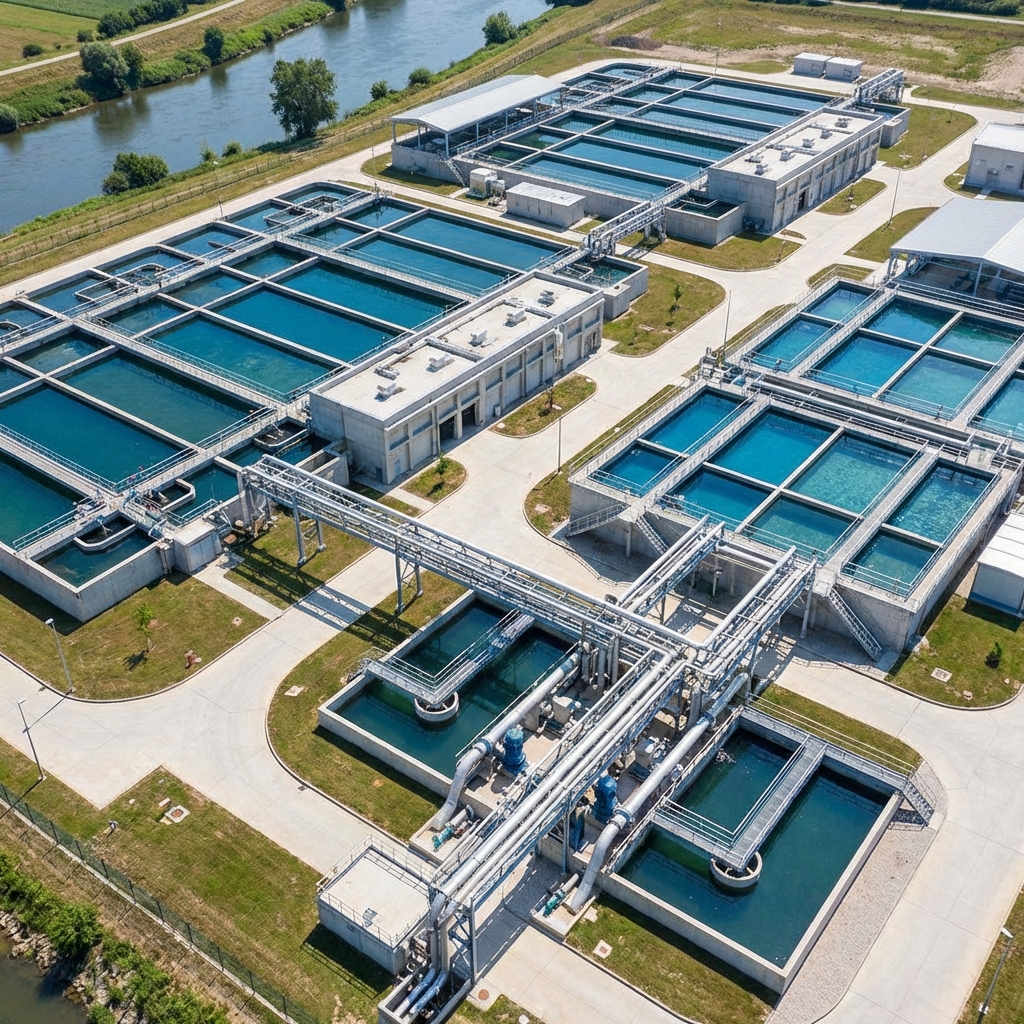
Water and wastewater infrastructure projects form the backbone of any residential or industrial community. From providing clean water to treating liquid waste, these projects require a deep understanding of hydraulic, structural, and mechanical engineering. In this foundational article, we'll explore the main types of these projects and the core concepts that will be the focus of our upcoming series.
What Are Water & Wastewater Infrastructure Projects?
These projects include all facilities and networks responsible for:
- Purifying and treating drinking water from natural sources
- Transporting and distributing water to consumers
- Collecting wastewater from buildings and facilities
- Treating wastewater before disposal or reuse
- Managing stormwater and surface drainage
💡 Sector Importance
The water and sanitation sector accounts for a significant portion of infrastructure budgets in both developing and developed countries. In Egypt, for example, billions are spent annually on expanding and modernizing these networks.
Types of Water & Wastewater Projects
In this series, we'll cover five main types of projects:
💧 1. Water Treatment Plants (WTP)
Converting raw water from rivers, wells, or seas into potable water through sedimentation, filtration, and disinfection processes.
🏭 2. Wastewater Treatment Plants (WWTP)
Treating wastewater from homes and factories to remove contaminants before discharge or reuse for irrigation.
📉 3. Gravity Networks
Pipeline networks that transport wastewater by gravity from buildings to pumping stations or treatment plants, including main lines, branch lines, and house connections.
⚡ 4. Pumping Stations
Stations for lifting water or sewage when natural gradient isn't possible, including submersible and surface pumps and control systems.
➡️ 5. Force Mains
Pressurized pipeline systems that transport water or sewage from pumping stations to the next destination (treatment plant or gravity line).
Water Cycle in Urban Systems
To understand the relationship between these projects, let's trace the water journey:
Project Execution Phases
Any of these projects goes through the following phases:
1. Studies & Design Phase
- Technical and economic feasibility studies
- Topographic and geotechnical surveys
- Hydraulic design (flow and pressure calculations)
- Structural design of facilities
- Electromechanical design
2. Execution Phase
- Excavation and backfill works
- Pipe laying and welding
- Manhole construction
- Concrete works for stations
- Mechanical and electrical equipment installation
- House connections
3. Testing & Commissioning Phase
- Pressure testing for pipelines
- Performance testing for pumps
- Trial operation
- Training and handover
Common Materials in Water & Wastewater Projects
| Material Type | Application | Common Diameters |
|---|---|---|
| uPVC | Gravity sewer networks | 110 - 400 mm |
| HDPE | Force mains, water lines | 63 - 1200 mm |
| GRP | Large lines, aggressive environments | 300 - 3000 mm |
| Ductile Iron | Pressurized water networks | 100 - 1200 mm |
| Reinforced Concrete | Manholes, tanks | Per design |
| Stainless Steel | Station equipment, ladders | - |
Common Challenges in These Projects
⚠️ Geological Challenges
High groundwater levels, rocky soil, or collapsing sandy soil increase excavation cost and difficulty.
⚠️ Coordination Challenges
Conflicts with other utilities (electricity, gas, telecommunications) require prior precise coordination.
⚠️ Operational Challenges
Ensuring service continuity during construction for existing areas (Bypass Systems).
Reference Standards & Specifications
Water and wastewater projects are subject to strict specifications, including:
- Egyptian Code for Water and Sanitation
- AWWA - American Water Works Association
- BS EN - British and European Standards
- ISO - For pipes and equipment
- IEC - For electrical equipment
✅ Tip for New Engineers
Start by understanding hydraulic drawings (Longitudinal Sections) and Standard Details for pipes and manholes. These are the foundation for understanding any sewerage project.
What Will You Learn in This Series?
Over the next 40 articles, we'll cover in detail:
- Water Treatment Plants: Components, processes, design, execution
- Wastewater Treatment Plants: Treatment types, modern technologies
- Gravity Networks: Design, pipes, manholes, testing
- House Connections: Specifications, execution methods
- Pumping Stations: Types, pumps, control systems
- Force Mains: Design, welding, inspections
Quick Summary
- Water & wastewater projects include: Purification, Distribution, Collection, Treatment
- Five main types: WTP, WWTP, Gravity Networks, Pumping Stations, Force Mains
- Common materials: uPVC, HDPE, GRP, Ductile Iron
- Challenges: Geological, Coordination, Operational
- Specifications: Egyptian Code, AWWA, BS EN
🧪 Test Your Knowledge
1. What is the common abbreviation for wastewater treatment plants?
2. Which type of pipe is commonly used in pressurized force mains?
3. What is the main difference between gravity networks and force mains?