Before any foundation is poured or any column is built, there's a crucial step that determines the accuracy of the entire building: Setting Out the Axes. The primary tool for this process is the Batter Board (known as "Khanzira" in Egypt) - that temporary wooden structure that looks simple but carries an enormous responsibility.
💡 Important Note
Some confuse Batter Boards (the wooden frame for setting out axes) with Plain Concrete (P.C.) (the blinding layer under foundations). This article covers batter boards as a surveying tool, not concrete.
📑 Table of Contents
1. Definition and Local Names
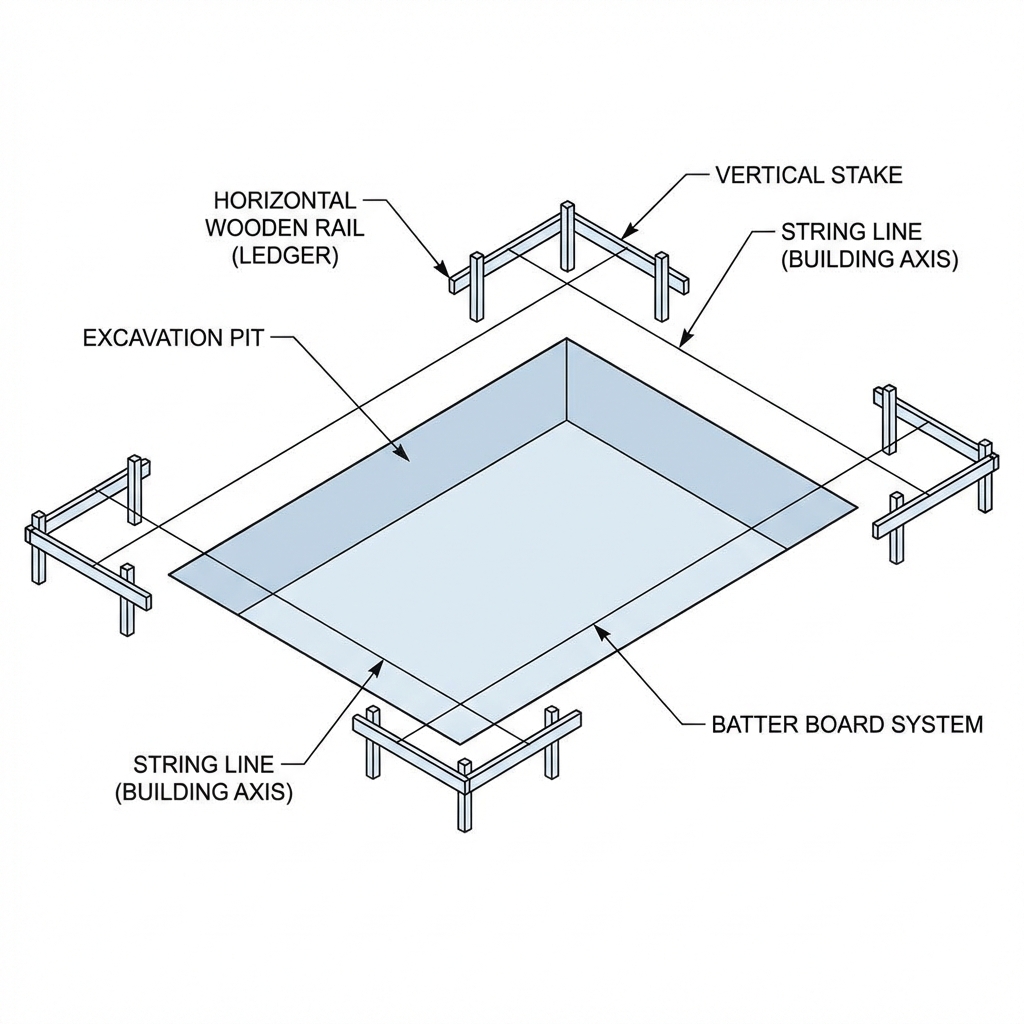
A Batter Board is a temporary wooden structure erected around the building perimeter or within the plot boundaries after excavation and leveling works. It serves as a physical reference for setting out building axes and transferring them accurately to the ground for controlling foundation, column, and wall positions.
Local Names
- Khanzira: Most common name in Egypt
- Reega: Alternative name in some regions
- Tahliqa: Used in some Arab countries
- Profile Board: Alternative English term
- Batter Board: Standard English terminology
✅ Practical Tip
When communicating with contractors or site supervisors, ensure you're using the same terminology to avoid confusion during handover.
2. Why Use Batter Boards?
The primary function of batter boards is to create the "Building Layout" that enables workers and engineers to execute elements in their drawn positions accurately. Batter boards serve several vital functions:
📍 Providing a Fixed Reference Frame
Batter boards act as a precise local coordinate system on site, remaining fixed throughout the foundation phase and used for transferring axes from drawings to reality.
🛡️ Protecting Setting Out Lines
They protect axis marks during excavation, backfill, and construction work, being elevated away from the work area.
📏 Facilitating Measurement and Adjustment
They provide a level and stable surface for stretching lines, taking measurements, and checking levels easily.
💰 Economic and Practical
A simple and inexpensive method compared to advanced surveying equipment, especially for small and medium sites.
3. Components in Detail
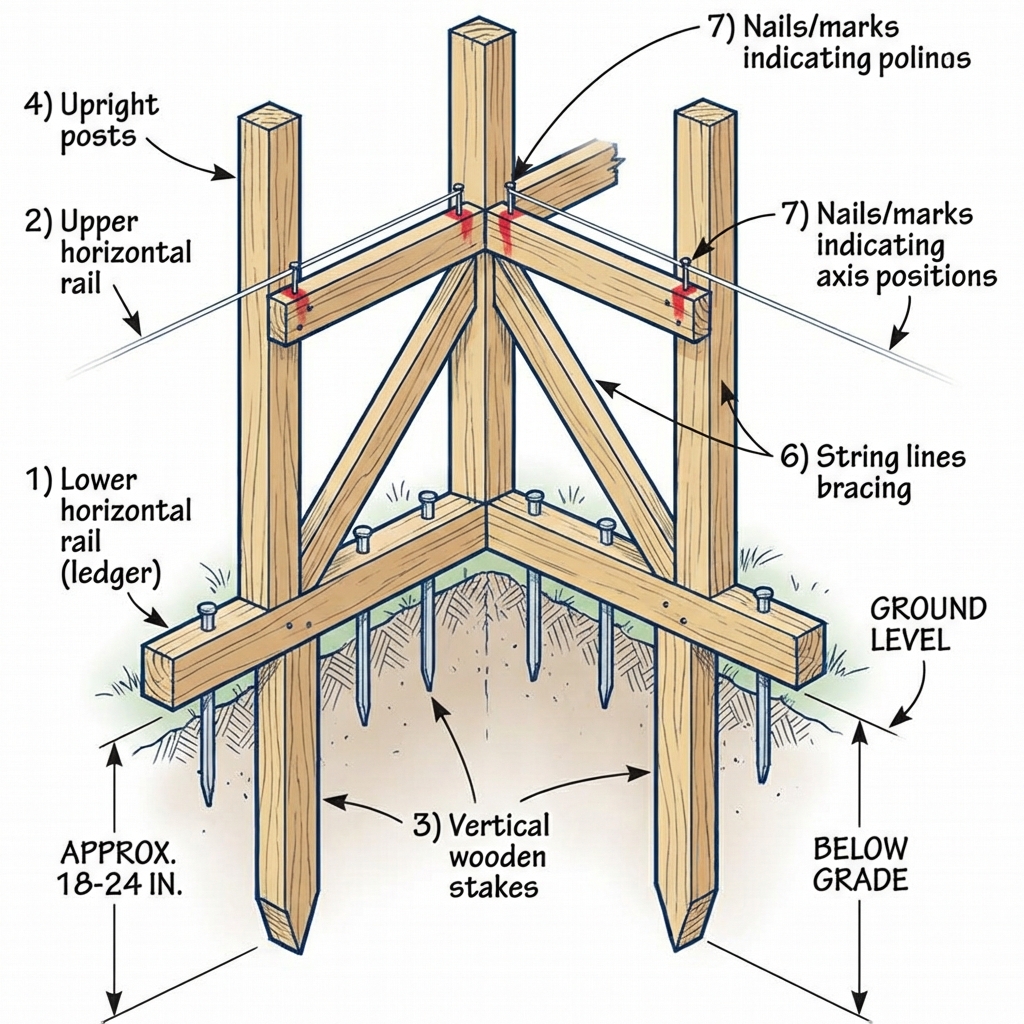
Batter boards consist of several essential elements, each with a specific role:
1️⃣ Ledger (Horizontal Rails)
Horizontal wooden members fixed around the perimeter. Usually there are:
- Lower Ledger: Fixed to the ground with stakes
- Upper Ledger: Carries the layout marks and string lines
Note: The vertical distance between them should be greater than the foundation height to facilitate adjustment.
2️⃣ Stakes (Pegs)
Pointed wooden sticks driven into the ground to secure the lower ledger. Can be replaced with steel bars when stronger fixing is needed.
3️⃣ Uprights (Posts)
Vertical wooden pieces connecting the upper and lower ledgers, holding the layout lines at the top. Their height determines where axes are marked.
4️⃣ Corner Blocks and Braces
- Corner Block: Placed at corners to secure perpendicularity
- Diagonal Brace: Diagonal connections for increased rigidity
- Connector: For joining ledgers together
5️⃣ String Lines
Cotton or plastic strings stretched between uprights to represent axes accurately. Prefer strings with good tension and low stretch.
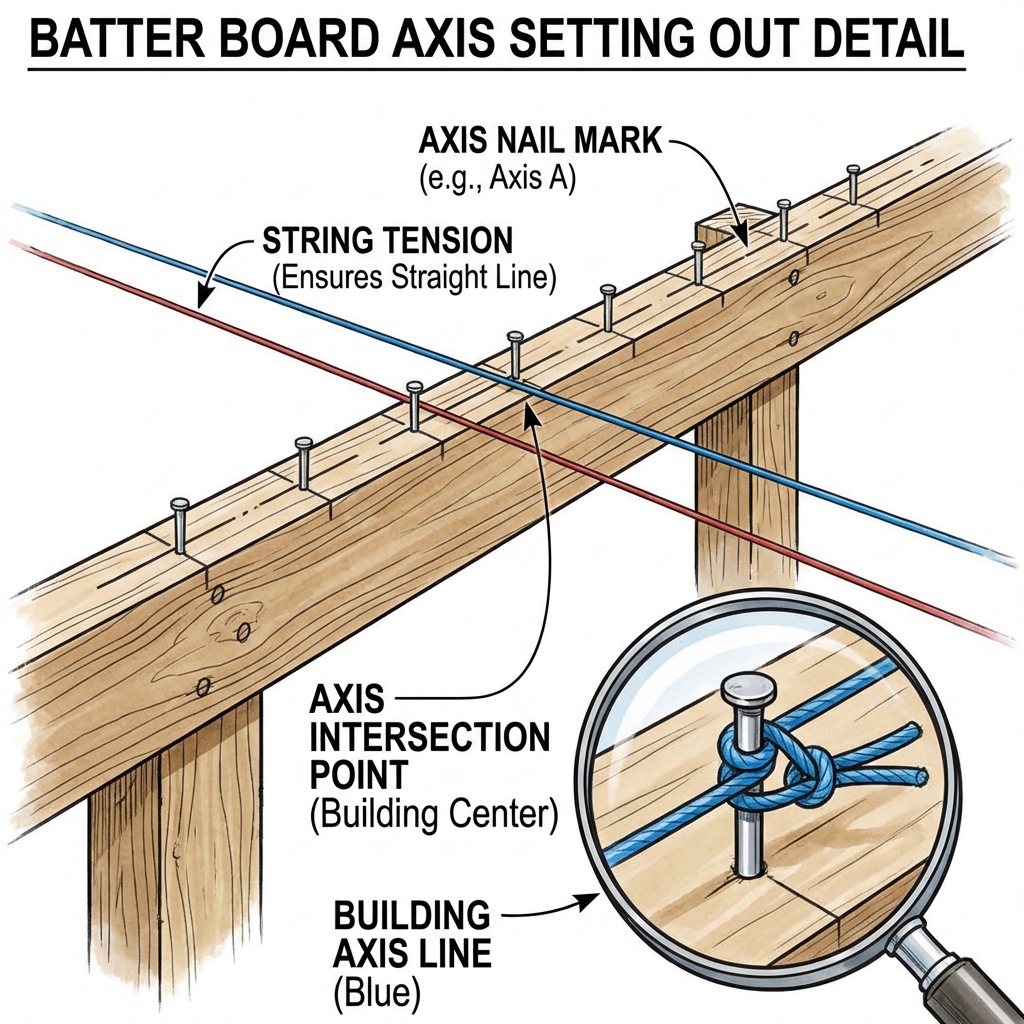
6️⃣ Reference Marks
Small nails or metal marks placed on the upper ledger as fixed points that can be re-measured later.
✅ Material Tip
Choose good quality timber (pine or similar) treated against rot if the batter board will remain for a long period. Ensure the lower ledger is well-fixed as any slippage directly affects layout accuracy.
4. Execution Timing in the Project
Batter boards are executed at a specific time in the work schedule:
| Phase | Description |
|---|---|
| Before | Completion of excavation and leveling at foundation level |
| After | Do not start before excavation is complete and site is cleared |
| Duration | Remains until foundation casting is complete and axes are confirmed |
| WBS | Listed under "Site Preparation and Setting Out" |
⚠️ Schedule Impact
Delaying batter board execution means delaying foundation casting! Therefore, it should be given priority at the start of execution.
5. Practical Execution Steps
A. Initial Preparation
Review Drawings
Check architectural and structural drawings and confirm the Benchmark point and origin (0,0).
Coordination Meeting
Site meeting including: Technical Office + Site Engineer + Contractor Representative + Surveyor. To clarify the starting point and horizontal/vertical references.
Establish Benchmarks
Save fixed known points on permanent elements (sidewalk, adjacent building) as reference for elevation measurements.
B. Setting Stakes and Lines
Drive Corner Stakes
Place outer corner stakes at sufficient distances outside the excavation limits. Use the 3-4-5 triangle to verify right angles.
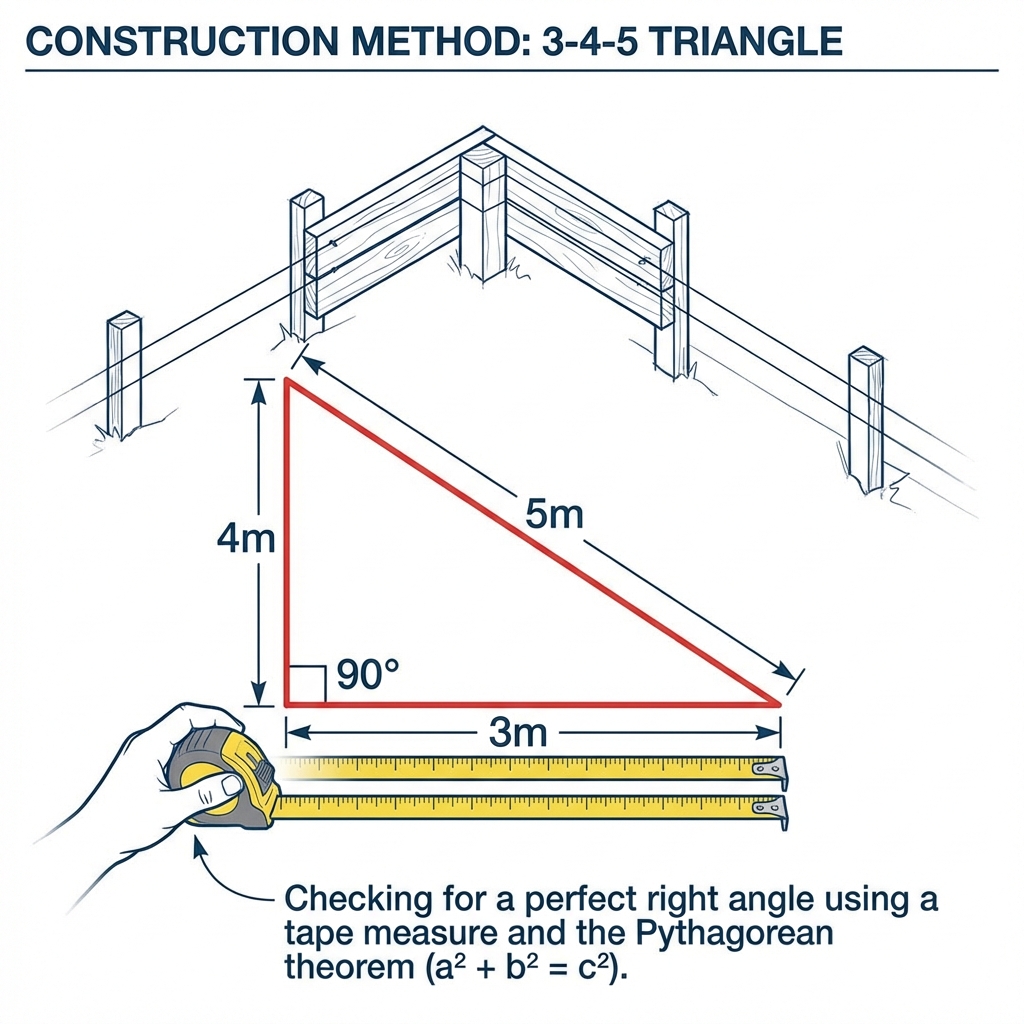
Check Perpendicularity and Parallelism
Use measuring tape and Pythagorean theorem, or a laser device to verify sides are perpendicular and parallel.
C. Installing Ledgers and Uprights
Fix Lower Ledger
Secure the lower ledger with stakes, ensuring it's stable with no looseness.
Install Uprights
Install uprights at a suitable height that allows stretching lines above the work area.
Install Upper Ledger
Fix the upper ledger and connect with connectors and corner blocks to ensure frame rigidity.
D. Setting Out Axes (Building Layout)
Transfer Axes from Drawings
Using measurements from drawings, place marks on the upper ledger for column and wall axes.
Stretch Final Lines
Stretch taut measuring lines representing centerlines, and place clear marks (colors/tape) at intersection points.
Cross-Measurement (Verification)
Take cross-measurements from different axes to confirm symmetry, parallelism, and accuracy. This is an essential step!
✅ Field Tip
Perform the "Double-Check" with two people (Engineer + Supervisor) or use a Total Station for confirmation. Small errors at this stage cause major waste later!
6. Setting Out Methods: Manual vs Modern
🔨 Manual Layout (Traditional Batter Board)
- Suitable for small and medium projects
- Requires skilled labor and continuous supervision
- Lower equipment cost
- Prone to manual errors
- Takes longer for adjustment
📡 Modern Surveying (Total Station / GPS)
- Very high accuracy
- Fast setting out
- Direct transfer from coordinate model
- Requires specialized technician
- Higher equipment cost
💡 Practical Recommendation
Use Total Station for precise initial transfer, then use Batter Boards as a physical reference on site. This combines digital accuracy with field flexibility.
7. Acceptance Criteria and Tolerances
| Item | Allowable Tolerance | Notes |
|---|---|---|
| Column Axis Position | ± 10 mm | Per project specifications |
| Corner Perpendicularity | 5 mm / 10 meters | Perpendicularity error over 10m |
| Line Straightness | Sag < 5 mm | At critical measurement points |
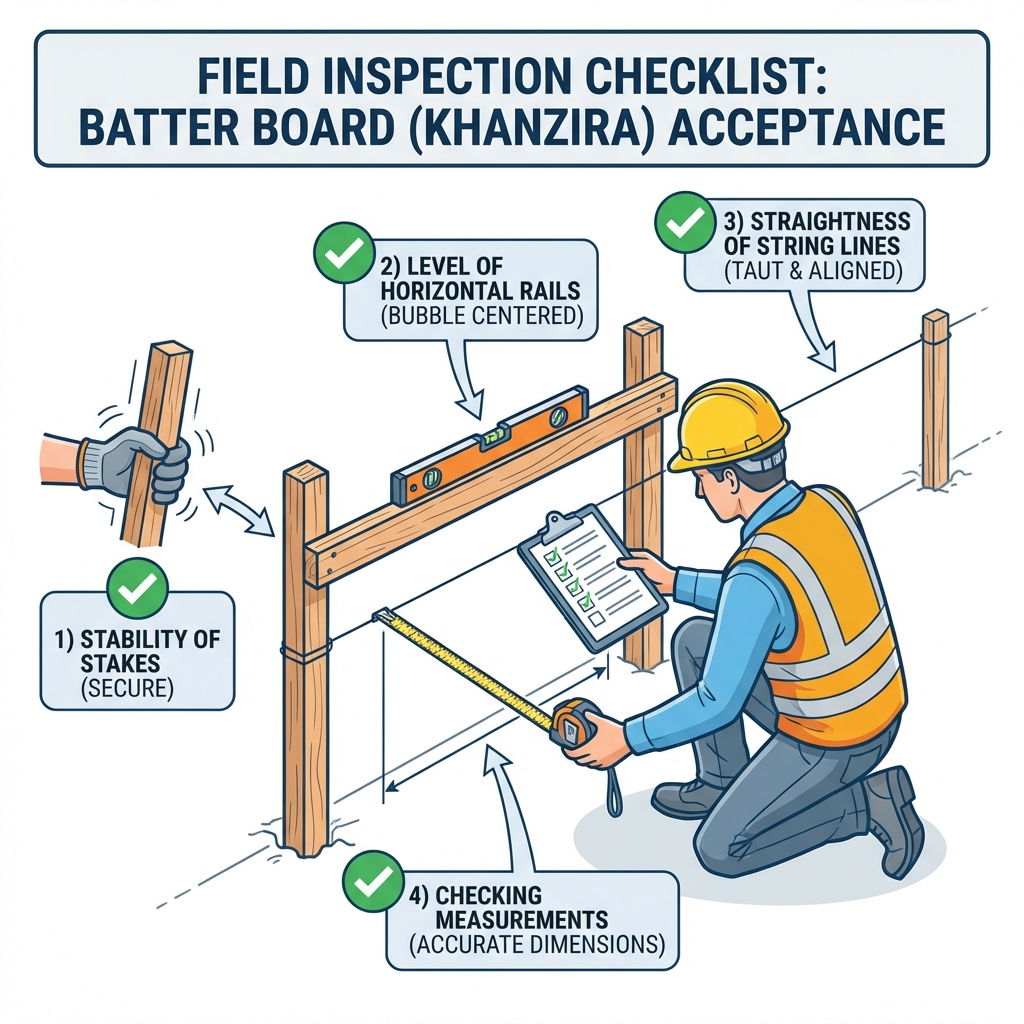
| Stake Stability | No visible movement | Daily inspection required |
⚠️ Important Note
The values above are common practical examples. Contract conditions and local specifications should be reviewed, as some sensitive projects require higher accuracy.
Acceptance Checklist
- ☐ Does the batter board match the latest drawing revision?
- ☐ Have Benchmarks been established?
- ☐ Are vertical ledger distances appropriate?
- ☐ Has corner perpendicularity been checked (3-4-5)?
- ☐ Have column marks been clearly fixed?
- ☐ Supervising engineer signature? Date?
8. Common Mistakes and How to Avoid Them
⚠️ Mistake #1: Weak Stake Fixing
Result: Ledger slippage and loss of axis accuracy.
Prevention: Use metal stakes or secure wooden stakes well, and check stability daily especially after rain.
⚠️ Mistake #2: Using Old Drawings
Result: Setting out wrong axes requiring rework.
Prevention: Confirm the latest drawing revision is on site before starting layout.
⚠️ Mistake #3: Not Preparing Handover Report
Result: Contractual disputes later.
Prevention: Put a standardized handover report template as a condition for starting foundation casting.
⚠️ Mistake #4: Neglecting Cross-Measurement
Result: Discovering errors after foundation casting!
Prevention: Always do Double-Check with two people or a different tool.
⚠️ Mistake #5: Leaving Batter Board Exposed to Damage
Result: Axis movement during site works.
Prevention: Place protection around the batter board and keep heavy equipment away.
Quick Summary
- Batter Board = Temporary wooden frame for setting out axes (not concrete!)
- Components: Ledger + Stakes + Uprights + Corner Block + String Lines
- Timing: After excavation and before foundation casting
- Accuracy: ± 10 mm for axes, 5 mm/10m for perpendicularity
- Most Important Tip: Always Double-Check!
🧪 Test Your Knowledge
1. What is a Batter Board (Khanzira)?
2. What is the "Ledger" in a batter board?
3. What is the most common Pythagorean triangle ratio for checking right angles?