Who Really Runs the Project?
Behind every official Org Chart lies an invisible web of power. If you don't manage this web, it will inevitably manage you.
📺 Watch the 2-Minute Summary
If you are short on time, watch this quick video summarizing the key concepts of "The Hidden Maestro".
Introduction: The Blind Spot in Project Standards
When we study for PMP or read the PMBOK guide, we learn about the "Stakeholder Register". The model seems simple and logical: Identify the person, determine their level of Authority and Interest, then place them in the Power/Interest matrix.
But as soon as you step onto a real construction site, you discover a harsh truth: Official authority does not necessarily mean the ability to influence.
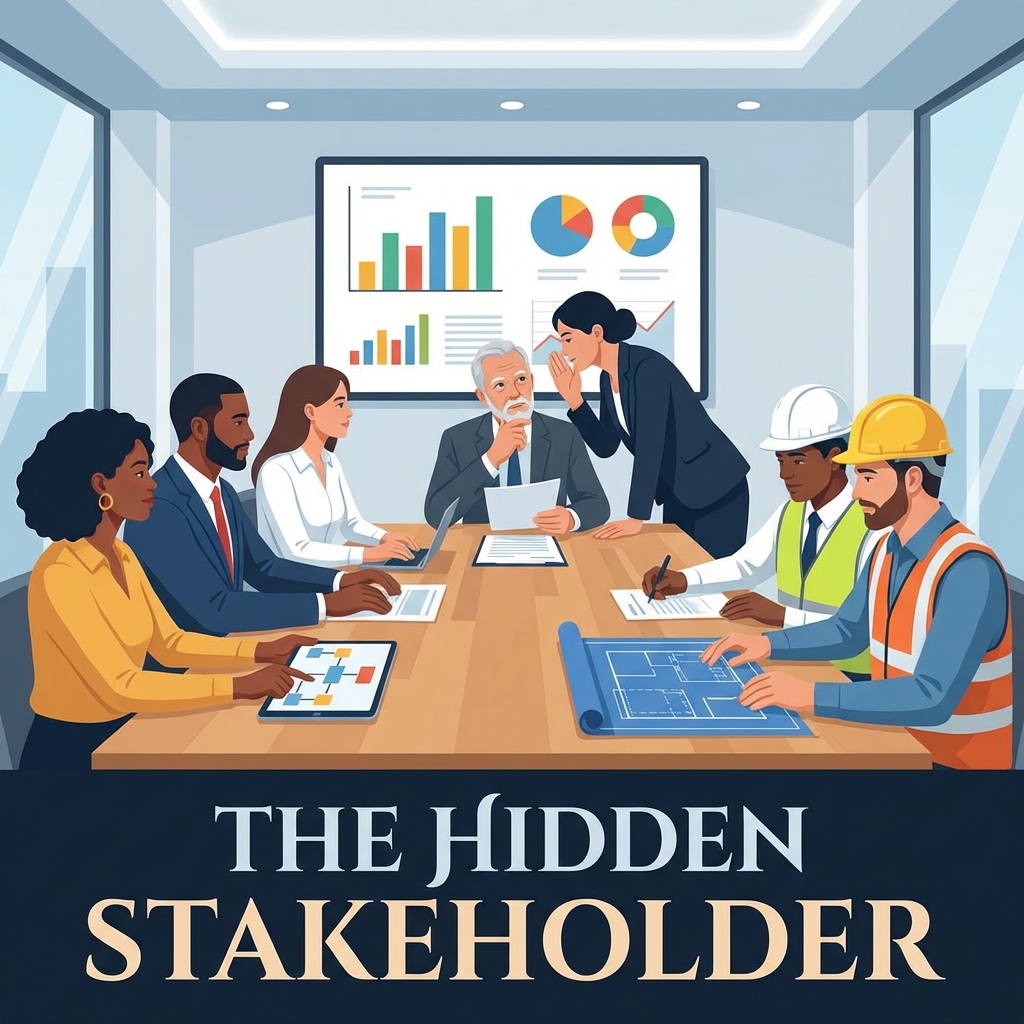
In every project, there is a "Shadow Organization". This organization doesn't appear in official minutes, signed invoices, or board meetings, yet it possesses the power to bring work to a complete halt or accelerate it miraculously. These are what we call the "Hidden Stakeholders", or as I like to call them on site: "The Hidden Maestros" who set the entire rhythm of the project.
🎯 In This Comprehensive Guide:
- Why the traditional "Stakeholder Register" fails to capture real risks.
- Psychological Profiling of the top 3 hidden figures on construction sites.
- Real-world Case Studies of projects stalled by ignoring these shadow players.
- "Coffee Intelligence" strategies and how to build a "Shadow Register".
Chapter 1: The Psychology of "Informal Power"
To understand how to deal with them, we must first understand the source of their power. In management science, power is divided into two types:
- Positional Power: "I am the Manager, therefore I command." This is the power PMBOK recognizes.
- Personal/Expert Power: "People follow me because they trust me or need me." This is the power of the Hidden Stakeholder.
🧠 The Institutional Historian
Someone who knows "where the bodies are buried". They don't hold a high rank, but they've been with the company for 20 years. They know the history of every buried cable and every decision made before you were born as an engineer. Their power lies in "Institutional Memory". Challenging them means you will repeat past mistakes only they know about.
🔑 The Gatekeeper
This could be the Client's secretary or the Store Keeper. Theoretically, their authority is zero. Practically, they hold the keys to access. If they decide the "Manager is busy", you won't see the manager. If they decide "Materials haven't arrived", work stops. Their power lies in controlling the flow of information and resources.
🤝 The Spiritual Leader
Often an elderly Foreman or a highly respected worker. Laborers don't follow your orders because you are the engineer; they follow the nod of his head. He is the unofficial union. If he feels disrespected, site productivity will drop 50% suddenly with "technical excuses" you cannot refute.
Chapter 2: Case Studies from the Field
Let's move from theory to painful reality. Here are real stories (names changed) illustrating the cost of ignoring hidden players.
❌ Case A: The Tower Stopped by "Lunch"
The Project: A 40-story residential tower in a crowded district.
The Situation: A new, energetic Project Manager (PM) decided to strictly regulate break times to boost productivity.
The Mistake: He ignored "Um Ibrahim", a simple lady selling tea and food to workers by the fence. The PM considered her an "uncivilized appearance" and banned workers from going out to her, mandating an expensive internal cafeteria.
The Catastrophic Result: "Um Ibrahim" wasn't just a vendor. She was an informal lending bank for workers, a safe deposit box, and a local community news hub. By banning her, the workers revolted "silently". Equipment started failing "mysteriously", and local supplies delayed because "Um Ibrahim" happened to be the aunt of the main loader driver in the area.
The Lesson: Social networks surrounding the project are part of your stakeholders, even if not listed in the contract.
❌ Case B: The Safety Officer's Veto
The Project: A massive petrochemical plant.
The Situation: Focus was entirely on pleasing the Client's "Project Manager". The junior "Safety Officer" was ignored and treated as a mere "paperwork hurdle".
The Result: This Safety Officer held "Stop Work Authority" in case of danger. Because he felt marginalized, he began enforcing the code with impossible literalism. He stopped concrete pouring 4 times due to "lack of scaffolding documentation", costing the project massive delay penalties.
The Lesson: The person with the "Stop" button is more important than the person with the "Start" button.
Chapter 3: How to Spot Them? (Site Intelligence)
How do you map the "Hidden Power"? Here are practical techniques not taught in universities:
☕ The "Coffee Machine" Technique (The Connection Map)
Observe who talks to whom during breaks. Who is the person that, when they speak, everyone quiets down to listen? Who do employees turn to when facing a personal problem?
Tip: The loudest person isn't necessarily the strongest. Look for the person who is "consulted" quietly.
🔎 Bottleneck Analysis
When a transaction or approval stalls, where does it stop? Trace the path. You will often find one name recurring. " The papers are with Mr. X". This "Mr. X" is a gatekeeper you must win over immediately.
👂 Listening to "The Silence"
In meetings, when a new idea is proposed, who do attendees look at before expressing their agreement? That quick, fleeting glance reveals the true decision-maker in the room.
Chapter 4: Containment and Engagement Strategies
Now that you've identified "The Maestro" or the Hidden Stakeholder, what do you do? Confrontation is often a losing game because they excel at bureaucratic "guerrilla warfare".
✅ Strategy 1: Recognition & Validation
Most exercise obstruction power because they feel "insecure" or "underappreciated".
Solution: Give them an informal title. Consult them publicly: "Chief X, what's your opinion given your long history on this site?". Once they feel their "value is preserved", they turn from a hidden enemy to a powerful ally.
✅ Strategy 2: Quid Pro Quo (The Trade)
For those controlling resources (like procurement or stores), understand their "currency". Do they want less hassle in procedures? Do they want training?
Solution: "Facilitate material release today, and I'll ensure your overtime is signed tomorrow." Look for a mutual win (Win-Win) outside rigid official channels.
✅ Strategy 3: Neutralization
If the person is "Toxic" and cannot be won over.
Solution: Don't attack them. Instead, "corner" them with Processes. Make their decisions require committee approval, or turn their discretionary power into a digital "Checklist" that leaves no room for moodiness.
Conclusion: Beyond Engineering
Project Management is 20% engineering and 80% human relations. The true guide to success isn't in memorizing PMBOK inputs and outputs, but in your ability to read the unspoken, interpret silence, and understand the human drivers that move the crane and sign the check.
In your next project, don't just look at the Org Chart on the wall. Look for the "Shadows". Look for "The Maestro". There lies the key to your true success.
🚀 Pro Tip:
Keep a private (top secret) Excel file called the "Shadow Register". Record these names, their personality keys (likes/dislikes), and their true influence level. This file will be the most valuable tool in your management toolkit.
Next Article: BIM Benefits: A Comprehensive Guide for All Parties